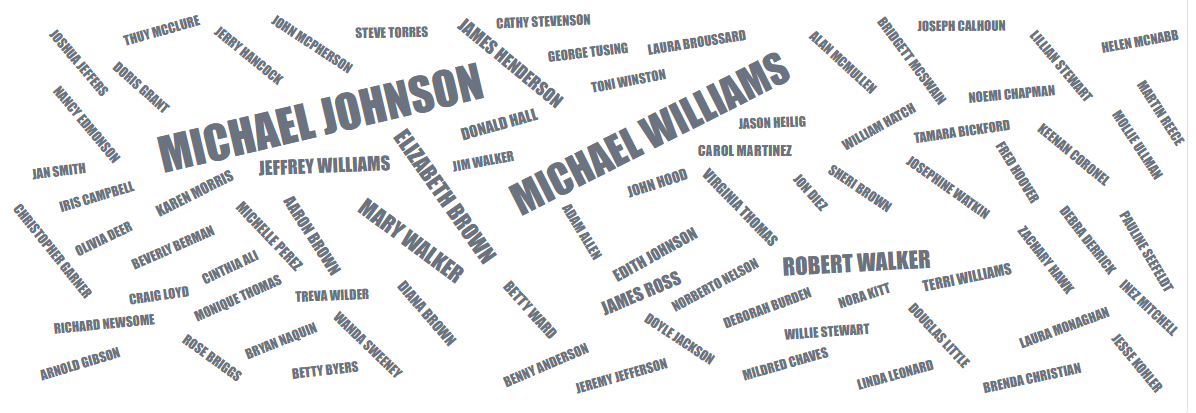
Introduction I’ll save you the trip to the dictionary: anthroponymy is the study of proper personal names, a subset of another fancy word—onomastics. The field covers everything from historical naming practices to given names, surnames, nicknames, and the cultural conventions that tie them together. Originally, this all started with a single article I wrote about […]
Author: H.M. Lü
AI Series Part 2: The Truth Behind “Generative AI”
A common depiction of generative AI is that it contains a large database of images and text. It then uses some algorithms to figure out and cobble together new images or text based on a user’s prompt. A simple back-of-the-envelope calculation shows this is far from the truth. Take the stable diffusion models, trained on the LAION-5B dataset, which is estimated at around 240 TB of already compressed images (particularly in JPEG format). However, the size of a trained stable diffusion model can be downloaded at just a few gigabytes. Common sense tells us that you cannot store 240 TB of data in a space that’s four to five orders of magnitude smaller. Additionally, these models contain no algorithmic code specifically to assemble images, and very little if any algorithmic code for interpreting text.
The Art of Debugging
Debugging is a crucial aspect of software development, but it can be a difficult and time-consuming endeavor for programmers of all skill levels. Despite its challenges, debugging is an unavoidable part of the process. I, personally, have found myself to be quite proficient in debugging, however, this can also be a curse as it often leads to being tasked with debugging not just in my professional life, but also in my personal life, such as when my elderly parents ask for my help troubleshooting problems without me being able to see the issue firsthand.
Self Publishing in the Digital Age
I decided to write this article after noticing a gulf between academic and technical writers and creative writers, particularly in their use of technology. My goal is to shed some light on these tools and their applications. Depending on the interest this piece generates, I might expand it into a series. If you find this […]
AI Series Part 1: The Robots are Coming, The Robots are Coming!
Well, not exactly, fellow writers. But with all the hype over the past couple of years, you’d think the robot invasion has taken place, particularly in the realm of generative art. Everywhere you look—news articles, social media posts, and so-called experts are touting the rise of machines creating content that once only humans could craft.
Amidst this buzz, a flood of misconceptions and misinformation has swirled, painting a picture that’s not entirely accurate. In the writing community, particularly, these misconceptions have been amplified by biases. I’m not here to defend the AI industry—I believe there was wrongdoing on their part, like downloading illegally from overseas pirate sites. However, I’ve seen tons of misinformation in writers’ forums and even in writers’ meetings.
My objective in this series is to illuminate the realities of present-day AI for writers. If after reading these articles you, as a writer, still hate and detest AI, that’s your choice. But at least you’ll be hating AI itself—not some distorted perception of it.