Introduction
I’ll save you the trip to the dictionary: anthroponymy is the study of proper personal names, a subset of another fancy word—onomastics. The field covers everything from historical naming practices to given names, surnames, nicknames, and the cultural conventions that tie them together.
Originally, this all started with a single article I wrote about Roman and Nordic names. That piece eventually split into what are now the second and third articles in this series. Then, during a meeting of the Writer’s Coffeeshop in San Diego, the topic of creating character names came up. One writer, noted naval thriller author Jeff Edwards mentioned using census data to help choose character names. I followed up by mentioning that I had written a small library that could generate names based on census frequency for creating fictional names in software, or for anonymization. At another time, another fellow writer from the same group suggested I expand into Chinese and Indian names. While I know virtually nothing about Indian names, I do have personal access to expertise in Chinese names.
Have you ever been stuck on what to name a character? Or just needed an authentic, believable name for an incidental character? That’s where anthroponymy becomes a practical tool for writers.
But I lie a little. This article, which kicks off the anthroponymy series, isn’t going to talk about name origins at all. Instead, it will supply information relating to two name generators available on this website. Hopefully the tools will prove useful.
Census Based Name Generation
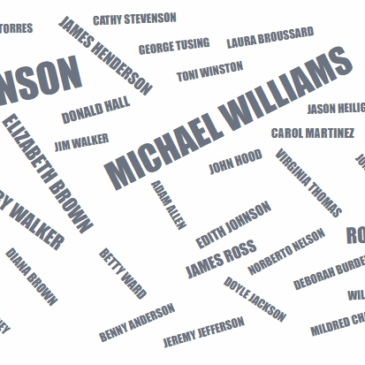
The first name generator can be found here 🡕, and it’s straightforward to use. You can generate first names, last names, and even filter by male or female names. The selections are weighted by frequency from the 1990 census. Each run produces six names at random, and for fun, it also generates a word cloud of up to 100 names (screen size permitting). Because the output reflects census frequency, common names are more likely to appear. Run it a few times and you’re almost guaranteed to see John Smith floating around in the word cloud. Personally, I find that every run surfaces at least one eye catching name—I hope you do too.
Now here’s where the data scientist in me emerges. The census includes over 4,000 female names and about 1,200 male names—a curious disparity in variety. For surnames, it lists more than 80,000, but anything with less than a 0.001% probability gets dropped, leaving around 18,000 last names. It’s worth noting that ethnic information isn’t encoded, so you’ll sometimes see first and last names combined from different backgrounds. Then again, in America’s melting pot, that might feel natural.
Name Generation by Era
Curiously, when I mentioned this tool on two different occasions at the Writer’s Coffeeshop, two New York Times bestselling authors reacted in exactly the same way: “Can it generate names by time periods?” At first, I said no. But here’s where I have to give credit to ChatGPT—it pointed me to the Social Security Administration, which maintains lists of popular first names by decade. From that, this second name generator was born.
Now for the usual data disclaimer: the data used comes from Social Security records of first names, which list the most popular names by year and which I aggregated by decades. This aggregation can skew the statistics, since names may drop off the yearly lists when they fall below the popularity threshold, so it lacks statistical rigor. The data also comes only from Social Security applications, so you can imagine that not everyone is included, particularly those prior to 1900—another statistical issue. However, it does give a flavor of the decade. As the statistics do not include last names I have to rely on the US Census. I pulled the last names from the 1990 Census as above. But I think surnames, as a general rule, aren’t as volatile as given names. In a nutshell, while not statistically rigourous, this generator will produce names with the flavor of the decade.
Which one to use?
Both are based on general U.S. names, and last names come from the 1990 Census. The Census Name Generator uses Census data, and its first-name depth has what we data geeks call a long tail—meaning more unusual options but at a low probability. The first names used in the Name Generator By Era are based on Social Security birth names. The year-by-year resolution is finer, but it drops the long tail.
Beyond the geek speak: the Census Name Generator can give you more unusual first names with low probability. The Name Generator By Era gives you names that fit the decade’s statistics.
“Terms of Use”
The title is a little tongue in cheek. In “legal speak,” the tool is free to use—commercially or non-commercially—though it’s intended for writers looking for character names. It is provided as is, with no warranty, and I’m not responsible for its output. Without a real “terms of use,” here’s the fair warning: the names are random, coincidences happen, and I can’t promise they won’t match a real person. In fact, there’s a strong chance someone in America does have that name—after all, the data comes straight from the U.S. Census.
As for support: if you find it useful—especially if it sparks the name of a significant character—please help spread the word. Talk up the tool on your own sites, blogs, or social media. I welcome and encourage linkbacks to the tool and/or my main website. After all, I’m a personal press trying to get noticed.
At the time of this release, I don’t have anything published. But if you come back later and buy one of my books, that would be the best way to show support and thanks.
In Closing a Little Onomastics
I’ll leave you with a tip out of onomastics. This anecdote came from posts I read in an author-help Facebook group. A budding author was struggling to come up with a name for a ritual or festival and was asking for suggestions. The first question I asked was what sort of culture the festival should be framed in—even a fictitious one. Most great fantasy writers lean into one or more existing cultures. That makes their worlds relatable and plants a kernel of reality, even familiarity, into a fanciful world. Tolkien was perhaps the most detailed, drawing from Celtic and Norse traditions. Of course, that was his profession—he was a professor of Old English and Old Germanic languages—and he went so far as to invent entire language systems. Others, like C. S. Lewis, mashed up familiar cultural elements—classical civilization, medieval chivalry, and fairy tales—into Christian allegories. So, if you haven’t already, ground your world in something familiar.
Here’s where just a little knowledge of onomastics can go a long way. Take ancient Rome, the domain of my novels and short stories. The suffix -alia was used to denote festivals like Bacchanalia (for Bacchus) and Saturnalia (for Saturn), which might already be familiar to some of you. There’s also one of my favorites from high school: Robigalia (for Robigus, the god of mildew—yes, that was a thing). Rome had a whole pantheon (pun intended) of -alia: Veneralia (note the use of the correct root of Venus, for all you “Venusians” out there), Lupercalia, and Floralia. The suffix has even survived into the modern age as -ale, as in Bacchanale. So if you’re planning a modern festival of mildew, call it a Robigale.
Beyond Rome—if historical accuracy is crucial, do your own research. My knowledge of the rest is somewhat superficial but probably reliable enough for fantasy names in a story.
From the Germanic languages we get probably the most recognizable suffix: -fest. Obviously, everyone has heard of Oktoberfest, which often comes with its modern cousin Beerfest. But the suffix has spread widely in modern usage: Comicfest, Geekfest, and Songfest, to name a few. While it’s a legitimate convention for naming a festival, the fact that it can be seen as short for “festival” and is so familiar can come across as a little too obvious or not exotic enough.
You also have Medieval Christian traditions that used -tide or -mas for festivals (still extant in Yuletide and Christmas today). These endings retain a sense of familiarity without being quite as on-the-nose as -fest.
For a little ancient Greek flavor, there is the suffix -ia. I’ll confess my knowledge of Greek morphology is weak to non-existent, but my understanding is that this suffix abstracts a noun into one meaning “things related to.” By cultural convention, it often came to denote festivals depending on context and usage—for example, Panathenaia and Dionysia.
And let us not forget the Norse. The suffix -blót literally means “sacrifice” and came to signify sacrificial rituals or festivals: Dísablót, a sacrificial ceremony honoring female spirits; Jólablót, the midwinter sacrificial feast; and Ásablót, a sacrifice to the Æsir.
Of course, in a fantasy world of your creation you could mash these up—Veneriblót, a sacrificial festival in honor of Venus… well, maybe not. But with a little digging, you can find a naming convention perfectly suited to the culture or setting of your story.